
MIR PulsarOps AI Origin Story
A national telecom outage took down payment processing and consumer internet. What followed was a pilot and a rebuilt log pipeline.
Network operations, and the hour after an alert fires. We publish when it is worth reading.
One outage, one team drowning in logs, and the platform that came out of it.
A national telecom outage took down payment processing and consumer internet. What followed was a pilot and a rebuilt log pipeline.
Chronological, from the outage to where the platform runs today.
01
A telecom outage in Canada, and more log data than one team could read.
02
An open-source pipeline and an assistant built around a senior engineer's day.
03
Syslog formats from routers, switches, firewalls and load balancers.
04
A pilot, a production rollout, then dashboards and early warning insights.
05
From servers to APIs, added to the library of log formats.
06
Secure on-premise data centers and your own private cloud.
The same work, modeled over three years.
Download the CTO ROI briefThree-year estimate: five-person NetOps team, ~125 incidents/yr, triage cut from 8 hours to 1.
Everything else worth your time, from the same team.
AI-powered network observability for a major telecommunications provider.
Read the case study
The platform brief and the CTO value brief, both as PDFs.
Open the library
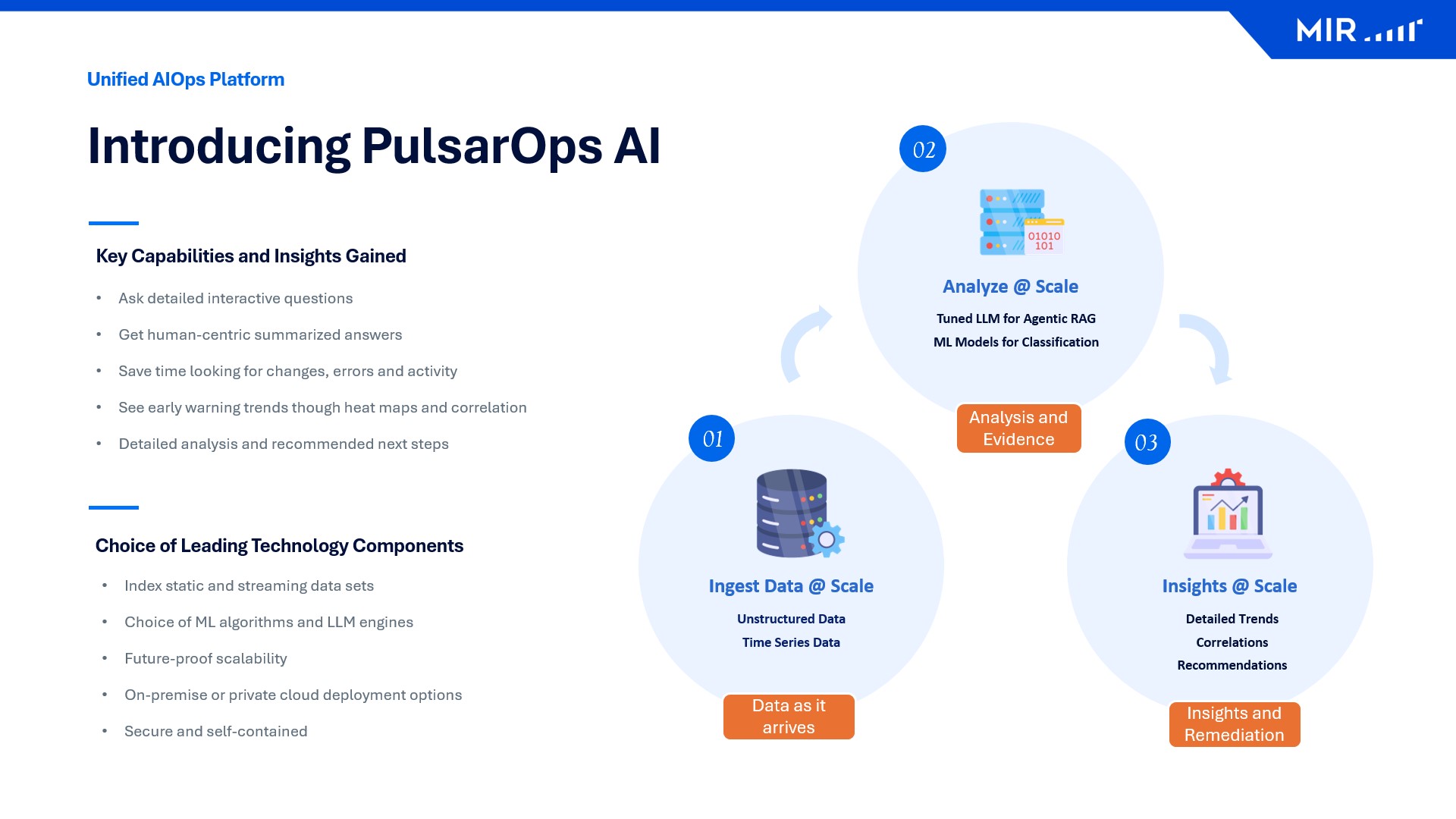
What arrives, what happens to it, and what an engineer gets back.
See the platform
Against log analytics, monitoring suites and cloud-only AIOps.
See the comparison
On-premise, sovereign-ready, cloud-agnostic. Your own perimeter.
Read the detail
MIR Digital Solutions, working with enterprise NOCs in North America and the Middle East.
About the team
What the platform ingests, and what your engineers get back.
We continue to focus and innovate so that our platform can scale to thousands of devices and millions of logs per day.
Thirty minutes with an engineer. Bring a real incident.