
Private by requirement
Runs inside your perimeter or your own VPC, with your keys and your controls.
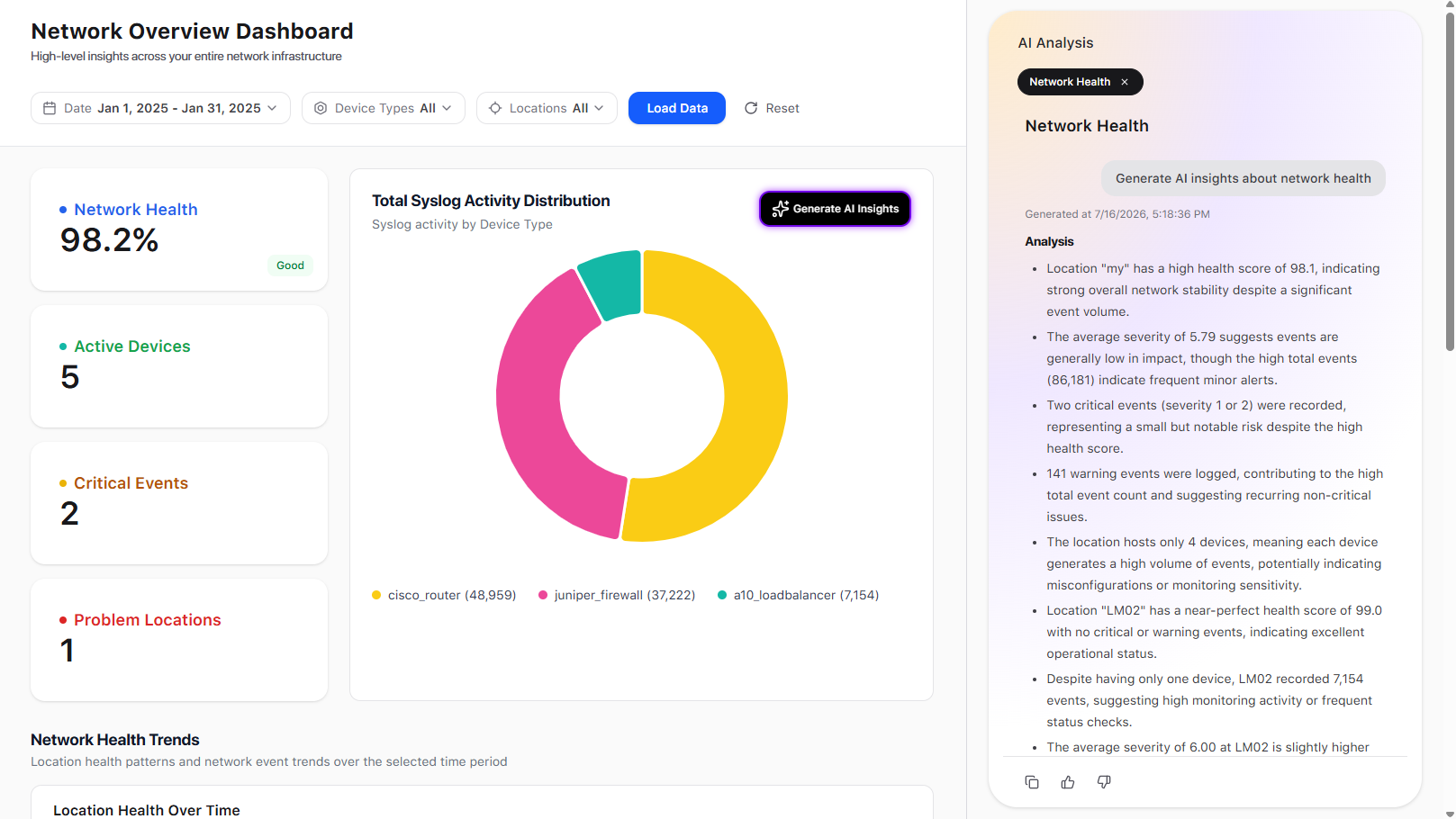
Many vendors, more alerts than anyone can read, and a business that notices the moment service slips. Event intelligence, on your own infrastructure.
Industry matters less than shape. If you recognize your infrastructure in this list, the rest of this page is written for you.
Enterprise NOCs worldwide
thousands of devices
Built for thousands of devices, millions of logs.
The most vendors, the most events, and the least room for a slow answer.
A major North American provider came to MIR Digital Solutions to modernize network operations.
Uptime and private deployment carry the weight here. Both are answered by where the platform runs.
Runs inside your perimeter or your own VPC, with your keys and your controls.
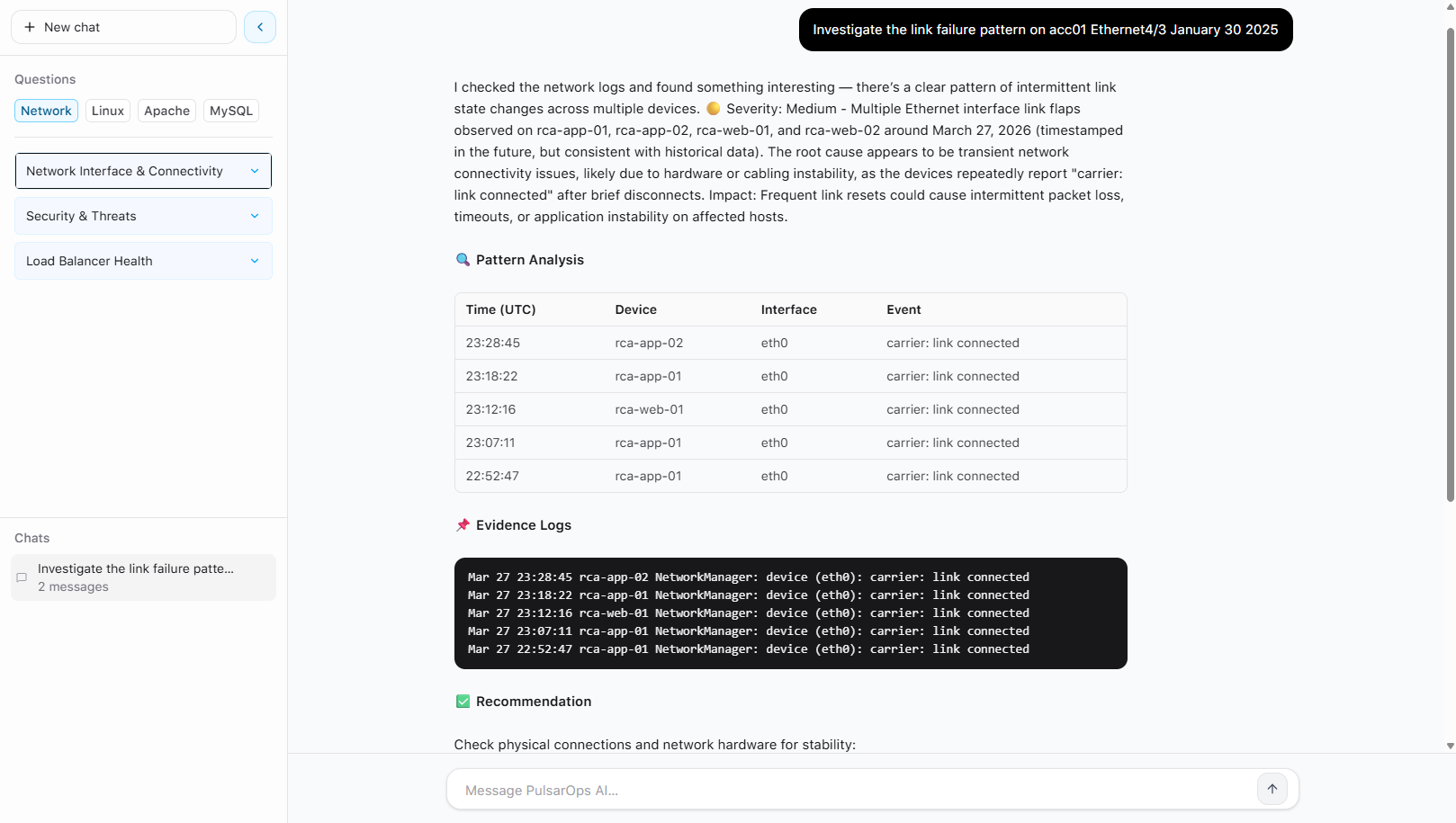
Correlation and root cause arrive with the alert, not at the end of a manual investigation.
PulsarOps AI runs alongside your existing systems and converges their data into one pane.
Operational data keeps growing. The operations team does not.
We would rather walk through a real incident than guess at your infrastructure from the outside.
Bring us a real incidentReading millions of events by type and frequency scales badly with people. That is the part the platform takes.
Distributed, heavily regulated, and often bound by in-country data rules that rule out a cloud-only approach.
01
Ingest is vendor-agnostic and multi-protocol, so nothing gets normalized by hand first.
02
The data stays where the regulator says it stays. The platform comes to the data.
03
Early-warning trends surface degradation before it becomes an outage.
The defining trait is volume. When the data outgrows the people who can read it, another dashboard does not help.
Most teams here can already reach every log they need. Getting intelligence out of it is the slow part.
Including the engineering and construction organizations that build them. We treat it as one account-level vertical.
An intelligence layer for understanding complex infrastructure and investigating operational issues. We validate the exact use case with each organization.
Seven possible seats at the table. This runs as an account, not as one conversation.
Devices in the infrastructure live
quietfailing
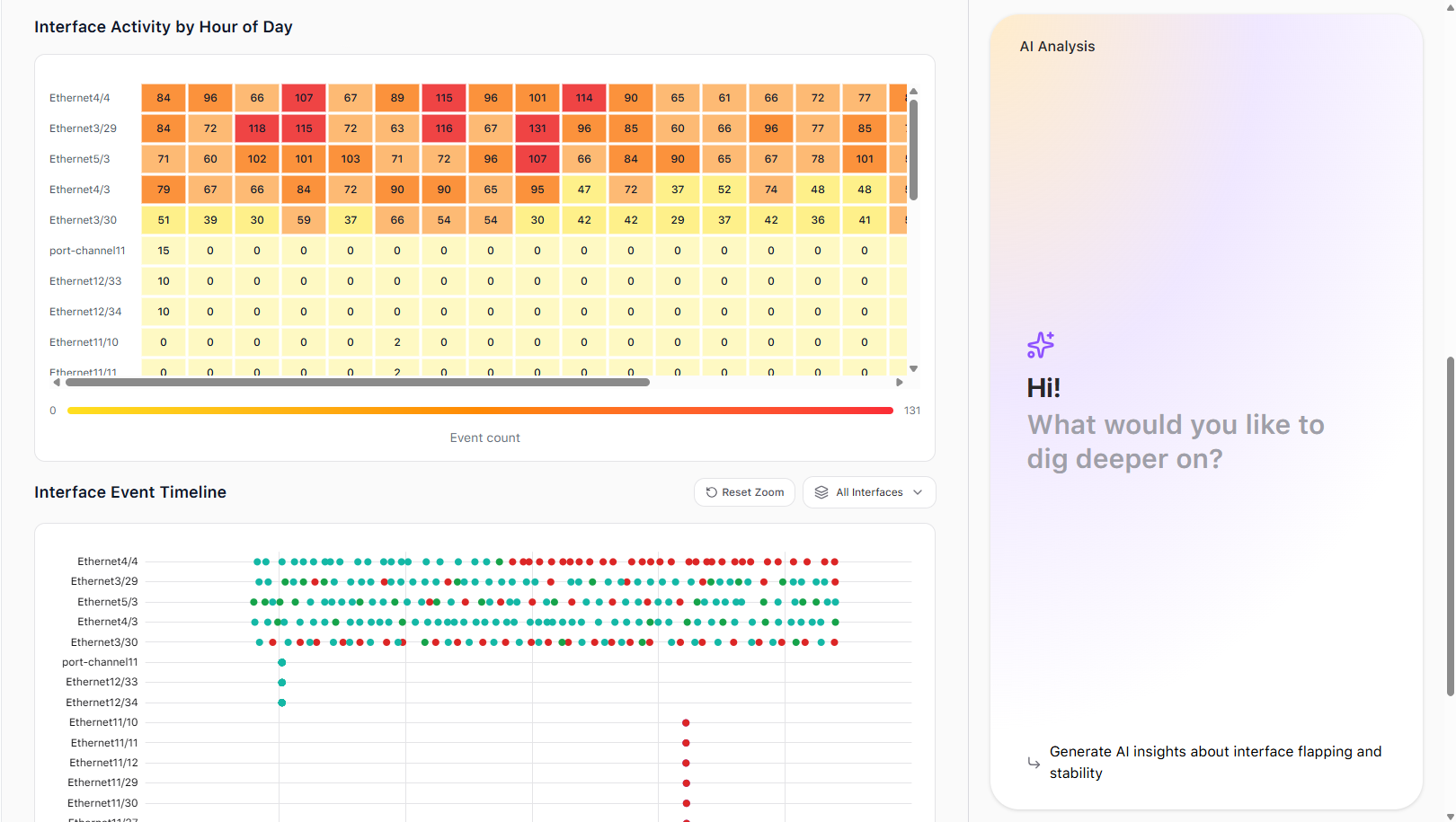
Heat gathers where the fault is, not everywhere.
Logs, configs, inventory and topology land in the same pipeline, so the operating team inherits a searchable infrastructure instead of a folder of drawings.
However many there are, they arrive through one vendor-agnostic, multi-protocol pipeline with an adaptive device library behind it.
Multi-device correlation groups the related events, so the issue presents as one thread with evidence instead of several alerts.
Worth measuring before and after. Ask in plain language, get an answer with the supporting logs and a next step.
Correlation. That is why the ML that identifies related error logs sits at the center of the platform.
The strategic case and the financial case are different arguments.
The conversation is about moving from reactive troubleshooting to an operating model where context arrives with the incident.
Themes: operational resilience, unified intelligence, reduced downtime risk, scalable operations.
Downtime reaches revenue, productivity, SLA performance and reputation.
Metrics worth pulling first: MTTR, incidents per month, hours spent investigating, cost per incident.
Both are measured on numbers that only move when investigation itself gets faster.
Alert queue by arrivalby severity
Severity orders the queue.
The hook is faster root cause analysis, because that is what the role is judged on.
Best engagement is a live demonstration on a real incident. They do not buy from a slide.
The hook here is workflow efficiency rather than raw capability.
Several engineers and sysadmins work in the platform at once, which is what makes a consistent workflow across shifts possible.
Modeled over three years on a real deployment shape.
Download the CTO ROI briefThree-year estimate: five-person NetOps team, ~125 incidents/yr, triage cut from 8 hours to 1.
Three-year estimate: five-person NetOps team, ~125 incidents/yr, triage cut from 8 hours to 1.
For most of the industries above, private deployment is a condition of the deal rather than a preference.
Read the security detailRuns inside your perimeter. Nothing leaves your network.
In-country deployment for government and regulated industries.
Your VPC on AWS, Azure or GCP. Your keys, your controls.
Thirty minutes with an engineer. Bring the CTO, the operations lead and a real incident.